
Plane Time Calculator
How long is the flight, and what time will it be when you land? Pick two airports and a departure time, and this calculator estimates the time in the air from the great-circle distance, then converts the arrival into the destination’s local time — including daylight saving. A second tool adds up flight times for a logbook.
- Free to use
- No sign-up
- Runs in your browser
Flight time calculator
Logbook time adder
Travel and Flight Log Template Pack
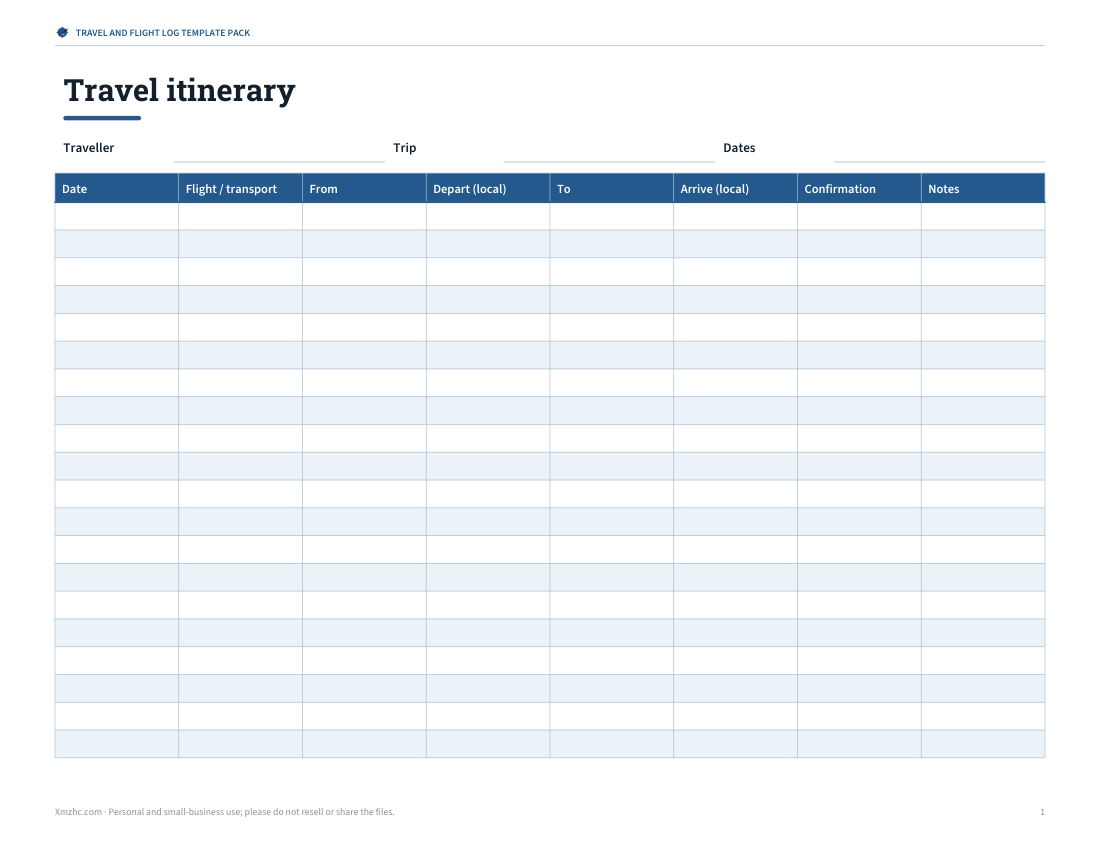
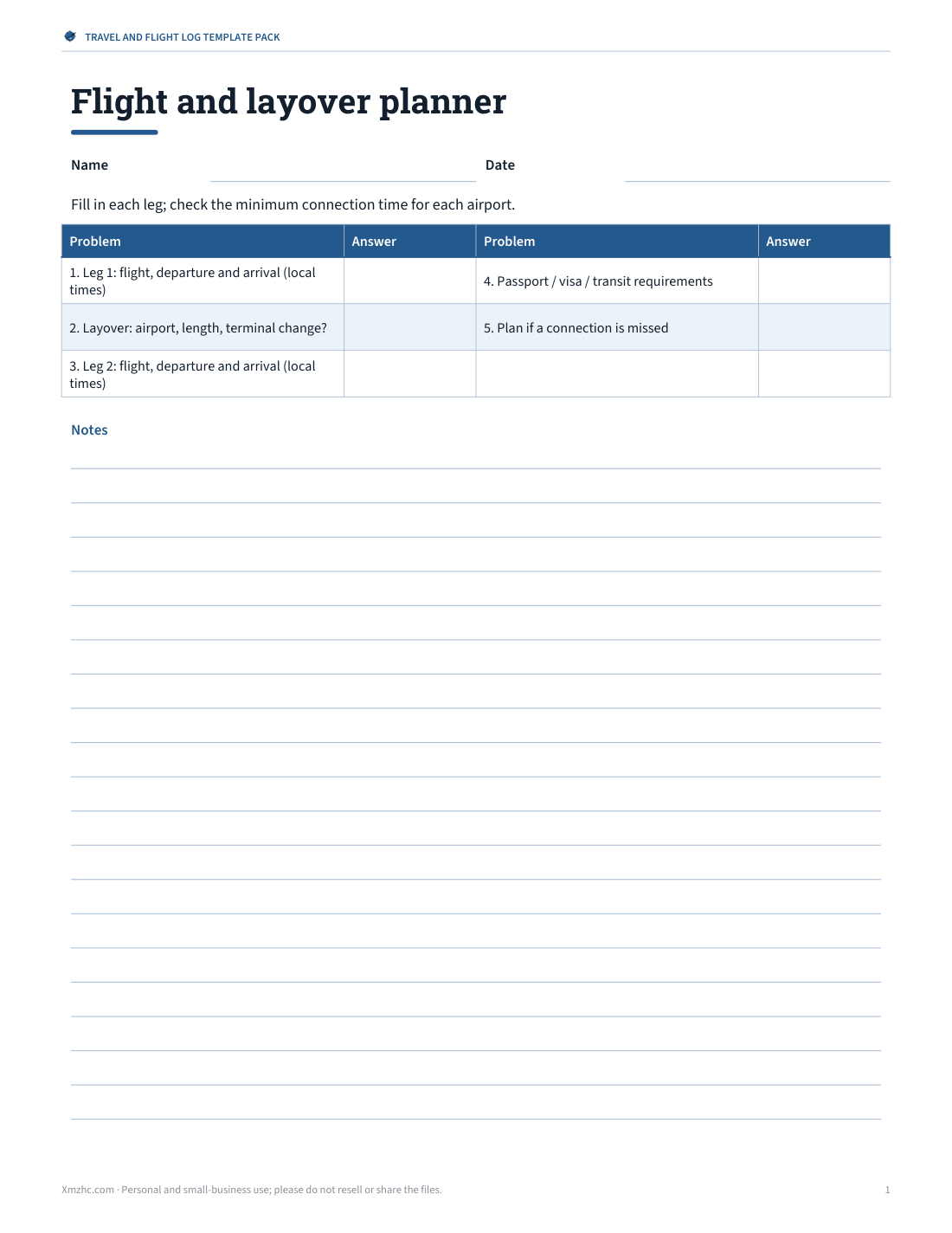
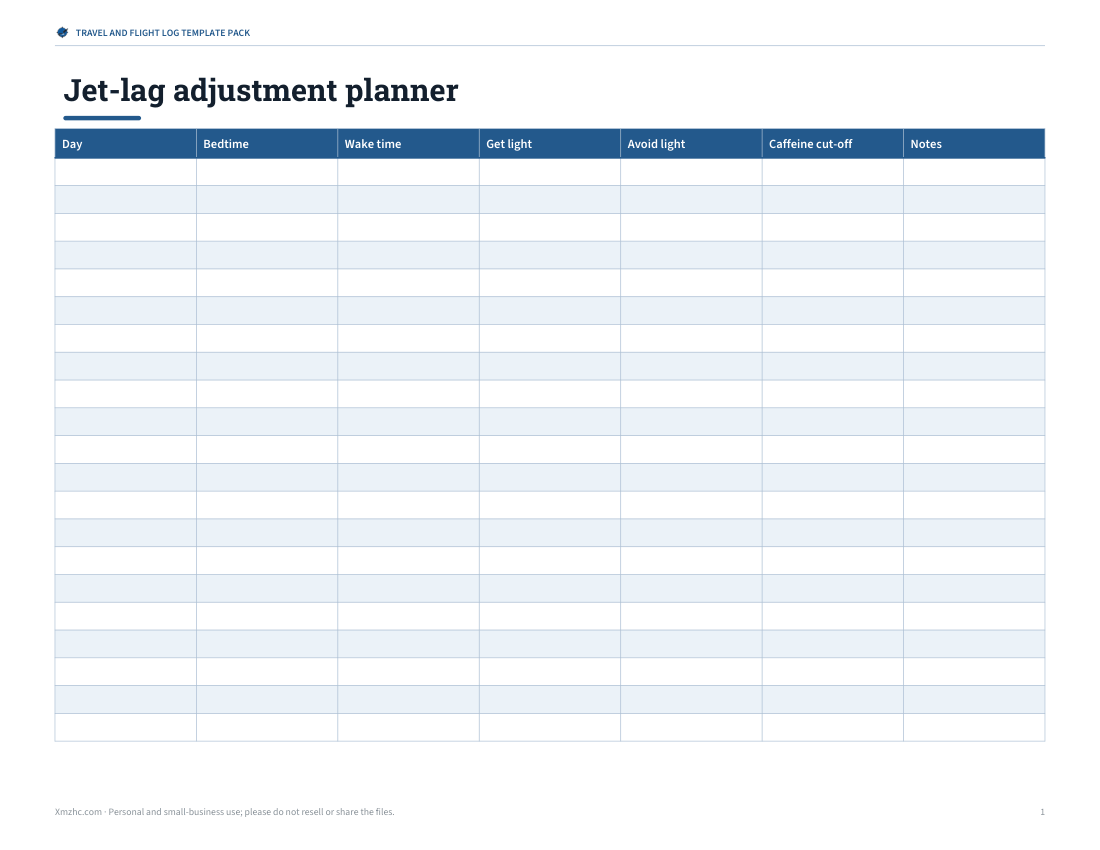
Travel itinerary template, flight and layover planner, jet-lag adjustment planner, personal flight log spreadsheet and a pilot-style logbook page with hours and tenths.
- Itinerary (PDF/DOCX)
- Layover planner (PDF/DOCX)
- Jet-lag planner (PDF/DOCX)
- Flight log (XLSX)
- Logbook page (PDF/DOCX/XLSX)
Formats: PDF, DOCX, XLSX. Instant download after payment (link valid 72 hours, up to 5 downloads). AI-assisted: the templates were drafted with AI help and reviewed and laid out before publishing.
$5.00 USD, one-time 5 files · about $1.00 each
- Instant download
- 7-day refund
- Secure checkout by Stripe
7-day money-back guarantee. Full refund within 7 days of purchase, even after you download.
Free sample: Travel Itinerary (PDF, 56 KB)
Full refund within 7 days — see the refund policy and license.
Free printables
Single sheets you can print right now, no sign-up. The full pack adds every sheet in one download plus the editable files.
 Printable Travel Itinerary Template
 Printable Layover Planner Worksheet
 Printable Jet Lag Planner
 Printable Flight Log Template
 Printable Flight Logbook Page
How flight time is estimated
- Find the great-circle distance — the shortest path over the Earth’s surface — from the airports’ coordinates.
- Divide by the average speed over the ground: cruise speed plus any tailwind or minus any headwind.
- Add an allowance for taxiing, climbing and approach, when the aircraft is slower than at cruise.
- Convert the departure time to UTC, add the flight time, and show the arrival in the destination’s time zone.
Jet airliners typically cruise around 480–560 mph (about 780–900 km/h) true airspeed. The 500 mph default plus 30 minutes gives a reasonable estimate for most jet routes.
Worked examples
New York JFK to London Heathrow is about 3,443 miles along the great circle. At 500 mph with a 30-minute allowance, that is 7 h 23 min. With a 60 mph tailwind from the jet stream the estimate drops to 6 h 39 min; flying back into a 60 mph headwind it rises to 8 h 19 min — which is why westbound transatlantic flights are scheduled longer. Los Angeles to Sydney is about 7,494 miles: 15 h 29 min at the default settings. Leaving LAX late on a Tuesday evening, you land in Sydney on Thursday morning local time — the calculator shows the date change as well as the time.
Great-circle routes
On a flat map, the shortest route between two distant cities looks curved. That’s because the Earth is a sphere and most map projections stretch high latitudes. A flight from New York to Tokyo heads north over Canada and Alaska rather than straight west, and the initial heading shown by the calculator is the compass direction at take-off along that shortest path. Real flights also follow organised tracks — over the North Atlantic, daily tracks are shifted to catch or avoid the jet stream — so the distance flown can be a few percent longer than the great circle.
Crossing the date line
Flights across the Pacific cross the International Date Line, where the calendar jumps by a day. Heading west from the Americas to Asia or Australia you “lose” a day; flying east you can land before you took off by the local clock. Because the calculator converts through UTC and then into the destination’s time zone, the arrival date is always correct — just remember to check hotel check-in dates and connecting flights against local dates.
Why the scheduled time differs
- Airlines add buffer for congestion and late departures (“schedule padding”).
- Routes follow airways and avoid restricted airspace, so they are longer than the great circle.
- The jet stream can add or remove more than an hour on long flights.
- Scheduled time is gate to gate (block time), including taxiing at busy airports.
- Connections add layover time and extra climbs and descents.
Time zones and daylight saving
The calculator uses each airport’s official time zone from your browser’s built-in time zone database, so it follows daylight saving changes on the actual travel date. Not every place changes its clocks: Phoenix stays on Mountain Standard Time all year, most of Asia doesn’t use daylight saving, and southern-hemisphere cities change in the opposite season to the north — so the difference between, say, London and Sydney changes twice a year.
Logbook time: hours and tenths
Pilots record flight time in hours and tenths (0.1 h = 6 minutes) or in hours and minutes, depending on the logbook and operator. The adder totals block times entered as h:mm and shows the result as h:mm, decimal hours and rounded tenths. Rounding each flight separately can give a slightly different total than rounding the sum — follow your operator’s or regulator’s rules for logging.
Beating jet lag
- Shift your sleep an hour a day toward the destination before a long trip.
- Get daylight at the right time at your destination — morning light after flying east, evening light after flying west.
- Stay hydrated and go easy on alcohol and caffeine in flight.
- Take short naps only, and try to sleep at local bedtime.
What’s in the template pack
- Travel itinerary template with flights, local times and confirmations
- Flight and layover planner worksheet
- Jet-lag adjustment planner
- Personal flight log spreadsheet (distance, time, airline, seat)
- Pilot-style logbook page with hours and tenths
The calculators are free; the pack is a one-time download.
AI-assisted content
This page and the templates were drafted with AI assistance and reviewed before publishing. Estimates are for planning; always use your airline’s schedule.
Frequently asked questions
How do you calculate flight time?
Distance ÷ ground speed, plus time for taxi, climb and approach.
How fast do planes fly?
Jet airliners usually cruise around 480–560 mph (780–900 km/h).
Why are westbound flights longer?
Prevailing westerly winds and the jet stream act as a headwind.
Does it handle daylight saving?
Yes, it uses each airport’s time zone rules for the date you enter.
What are hours and tenths?
Logbook time where each tenth of an hour equals 6 minutes.
Why does a flight to Asia go over the Arctic?
The great-circle route between distant northern cities curves toward the pole, which is the shortest path on a globe.
How do I know the local arrival time?
The calculator converts through UTC using the destination’s time zone rules for that date.
Can I use it for private or small aircraft?
Yes — set the cruise speed and allowance for your aircraft; for flight planning use official charts and weather.
Is the pack a subscription?
No, it’s a one-time download.